
How we classify risk
Seven levels, one score, and the reason behind both.
Pakkuvam classifies how safe a household looks right now — not how disciplined it is. Levels describe circumstances, and the safety score explains what is driving them.
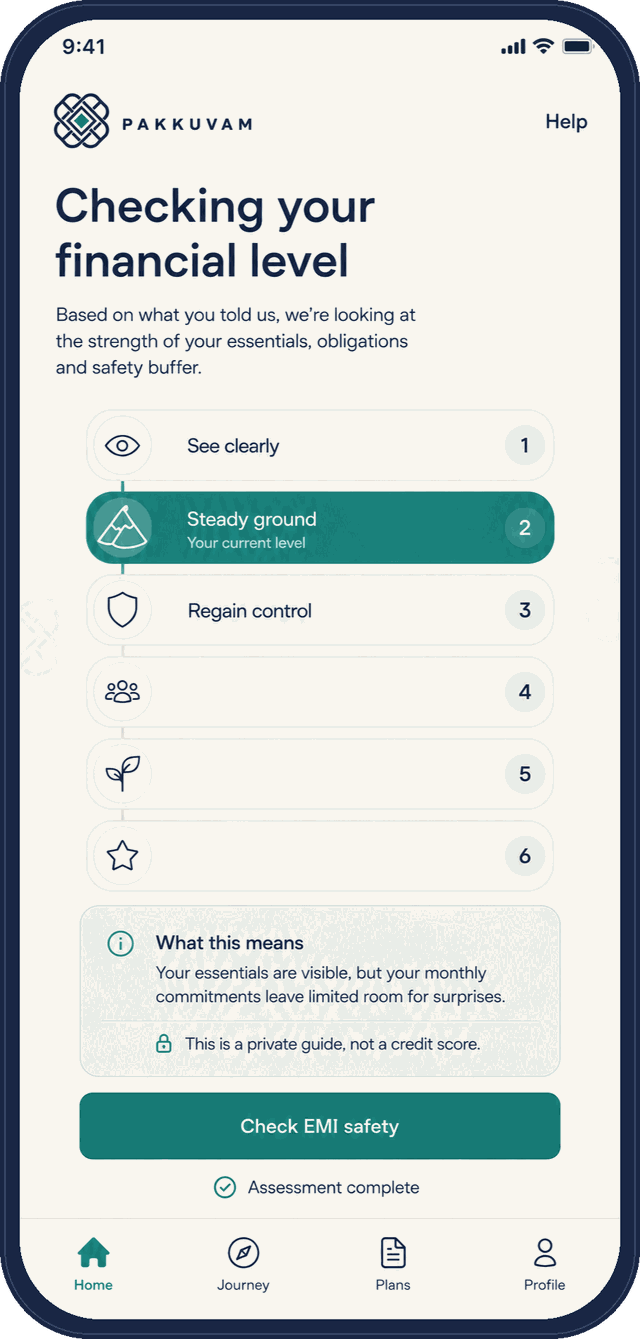
The seven financial levels.
Households move between levels as income, commitments and dependents change. Most households sit between levels two and four, and that is an ordinary place to start.
- 1
Under pressure
Essential costs are not reliably covered, and gaps are being filled with new borrowing.
- Income does not cover essentials in a normal month
- New credit is used to meet routine costs
Typical next step: Stabilise essentials first. No new commitments.
- 2
Cash-flow tight
A normal month just about works, but there is nothing between you and a surprise.
- Little or no gap between income and commitments
- No buffer for a missed week of income
Typical next step: Build the first 7-day buffer stage.
- 3
Cash-flow stable
Normal months are comfortable, but a difficult month would still hurt.
- Consistent surplus in a normal month
- Bad-month runway under one month
Typical next step: Extend the buffer and review EMI load.
- 4
Shock aware
You can absorb a short income shock without borrowing, and you know your weak points.
- One month of survival expenses set aside
- Health cover in place for most of the household
Typical next step: Reduce the most fragile commitment.
- 5
Debt controlled
Debt is planned rather than reactive, and it survives a bad-month test.
- EMIs stay affordable on bad-month income
- No revolving or high-cost credit in routine use
Typical next step: Fund expected costs before they arrive.
- 6
Household protected
Buffers, cover and planned funds work together, including for dependents.
- Three to six months of survival expenses
- Cover for health, income loss and dependents
Typical next step: Test bigger decisions with the Pakkuvam Pause.
- 7
Secure and choosing
Safety is not the question any more. Decisions are about choice, not survival.
- Long runway, low fragility, protection in place
- Major commitments are optional, not forced
Typical next step: Keep protection current as life changes.
The Pakkuvam Safety Score.
A single number out of 100, built from four parts. Each part is shown separately, so you can see which one is holding the score down.
Cash flow
Whether a normal month leaves room after essentials and commitments — measured with ranges, not exact figures.
Debt
How heavy commitments are, how costly they are, and whether they still work when income dips.
Shock resilience
How long the household can continue if income falls: buffer stages, runway and the commitments most at risk.
Protection
Cover for health, income loss and dependents — the part households most often postpone.
0–39
Fragile
A single difficult month would force borrowing.
40–59
Stretched
Normal months work; bad months do not.
60–74
Stabilising
Buffers are forming and debt is under review.
75–100
Secure
Shocks are absorbed without new borrowing.
How we hold these judgements.
- A level describes a situation, not a person. It can change in either direction, and it is never a judgement of character.
- Risk is measured against a bad month, not an optimistic one. Optimistic capacity is how households end up over-committed.
- Every level and score comes with the reason for it. If we cannot explain it in plain language, we do not show it.
- Nothing here is a credit score. It is not shared with lenders, employers or anyone else, and it does not affect your borrowing.
Financial difficulty does not reduce human dignity.